|
HAC News
February 2015
March Meeting Announcement
Our March meeting will be held at 7PM on Friday March 6. The meeting will be held in the main lobby area of the Cochise College Library. This is a change of venue due to the unavailability of our usual meeting location. Please note that previous announcements and event schedules had this meeting scheduled for the Patterson Observatory. That location is considered too small for the expected turnout. The lobby area of the Cochise College library can accommodate a significantly larger number of attendees.
The presentation for the March meeting will feature two distinguished speakers, Ric and Dolores Hill. Rik's talk will detail the near Earth asteroid search program of the Catalina Sky Survey. Rik has been on the CSS team since 1999. Dolores is a meteoriticist at the University of Arizona's Lunar and Planetary Laboratory. She will bring us up to date on the latest exciting news from the OSIRIS REx asteroid sample return mission that will launch toward the small asteroid Bennu in 2016 and return a sample to Earth in 2023. OSIRIS REx is being managed out of the University of Arizona in Tucson.
Rik and Dolores struck up a relationship through a common interest in astronomy and have been married for 35 years. Dolores's job at LPL is described as her dream come true. Rik came to the CSS via positions at Kitt Peak where operated the Burrell Schmidt telescope for the Warner & Swasey Observatory until 1992 when funding for that scope was terminated. He was then picked up at LPL to work with the Planetary Atmospheres and Planetary Occultation groups. When funding for that activity was terminated in 1999 he went immediately to work for the Catalina Sky Survey.
We will treat Rik and Dolores to dinner at the Outback Steak House before the meeting. If you would like to join us for dinner please RSVP to Ted Forte [ tedforte511(at)gmail.com ] and plan to be seated at 5PM.
February Star Party
We would like to invite everyone up for another Huachuca Astronomy Club member star party this Saturday Feb 21 at around 7 PM. We will have some munchies available but you are more than welcome to bring your own snacks if you like. I will post a message on the HAC list if the weather turns bad that afternoon. Please feel free to call me on my cell phone anytime, at 559-760-3827 if you have any questions.
Directions coming from East Bevers and Highway 92 is to turn east onto E Bevers from Highway 92 and continue for one mile. Continue past the stop sign on E Bevers and then turn left onto S Silver Lace Street. Turn right at the next street which will be E Lantana Dr and go to the end. We are located at the end of the cul-de-sac and on the left at 5515 E Lantana Dr.
There should be many great spring time objects to look at, again we hope to see everyone.
Gary and Aracelis Grue
5515 E Lantana Dr
Sierra Vista 85650
Cell 559-760-3827

HAC News
January 2015
January Star Party
We would like to invite everyone up again for a club star party this Saturday Jan 17 at 6:30 PM. We will have chips and sodas available but you are also welcome to bring your own snacks if you like. If the weather turns bad we will post a cancelation notice on the HAC list that late afternoon. Please feel free to call me on my cell phone, at 559-760-3827 if you have any questions.
Again the directions coming from East Bevers and Highway 92 is to turn east onto E Bevers from Highway 92 and continue for one mile. Continue past the stop sign on E Bevers and then turn left onto S Silver Lace Street. Turn right at the next street which will be E Lantana Dr and go to the end. We are located at the end of the cul-de-sac and on the left at 5515 E Lantana Dr.
We hope to see everyone
Gary and Aracelis Grue
5515 E Lantana Dr
Sierra Vista 85650
Cell 559-760-3827
February Meeting Announcement
The February meeting of the Huachuca Astronomy Club will be held on February 6th at 7 PM in Room 900 of the Cochise College Library building. Our guest speaker will be HAC member Alex Woronow from Silver City NM.
Dr. Alex Woronow has degrees in astronomy and geology. He was a Research fellow at U. Arizona's Lunar & Planetary Lab and a Professor of Geosciences at the U. Houston. He has held numerous NASA Planetary Research Grants and authored publications on statistical analysis of the surfaces of the Moon and planets. More importantly, he has been an amateur astronomer for almost 52 years, built his own telescopes, and photographed the planets and star systems. He is currently building an observatory near Silver City, NM where he hopes to contribute to professionals who pursue spectroscopy and polarimetry of super novae and nebulae.
Alex's talk is titled "Amateur Astro-Spectroscopy"
Facets of the physical and chemical attributes of stars, nebulae, and novae lie exposed to simple spectrographic equipment, affordable to many amateur astronomers. The spectrographic observations made by amateurs can contribute significantly to professional studies, and many "campaigns" organized through amateur interest-groups provide these contributions.
In Astronomy the accessible frequencies of light lie between the near infrared and the violet, bounded by the absorption of more extreme frequencies by the earth's atmosphere, at least for the earth-bound amateur astronomers. To a first approximation, stars emit light continuously across the visible spectrum, but ions, atoms, and molecules punctuate the continuum. Some of the ions and atoms, and a few molecules, may be near the stellar surface, in what is called the "reversing layer," or just below that, where the photons originate, in the stellar photosphere. Others may be in interstellar clouds that lie between us and a star. These three regions, and some significant others, lie open to spectroscopic analyses of pressures, temperatures, large- and small-scale motions, as well as chemical compositions.
This presentation will renew our understanding of light's interaction with its environment, look at the range of the equipment and software that amateurs use in their spectrographic observations, and survey some of the recent campaigns amateurs have undertaken in support of professional spectrographic studies.
We will be going to dinner at Outback before the meeting (5PM). Everyone is invited. If you can attend, please RSVP to me.
Our next Public Night at the Patterson Observatory is January 22, we'll begin about 6:15. Comet C/2014 Q2 Lovejoy should make a great target. There is a GRS transit on Jupiter that should be well placed around 9:15.
We have an outreach event at Joyce Clark Middle School on January 26 (6:30 to 8:30). Please plan to set up a telescope at the school if you are available. If you are new to astronomy outreach, this is a great venue to try your hand at it - come on out and I'm sure you'll enjoy the event!
Don't forget that HAC memberships expire in December. If you haven't yet paid your 2015 dues you are already delinquent. You can pay your dues at any of our gatherings or mail them to PO Box 922 Sierra Vista AZ 85636.
Clear skies,
Ted Forte
Huachuca Astronomy Club
The January Newsletter is Here!
A new issue of Nightfall, the official HAC newsletter, is now vailable! You can download
your January issue here! Thanks again to Cindy Lund for assembling the newsletter.
January Meeting Announcement!
The January meeting of the Huachuca Astronomy Club will be a FREE telescope clinic held at the Patterson Observatory on Friday, January 2, 2015 at 7PM. This is a change of location for this event. The public is invited to bring their telescopes to the clinic for help with assembly, alignment and operation. Weather permitting, telescope owners will receive individual help in navigating the sky and finding celestial objects. Guests will have the opportunity to view the sky with the observatory's 20-inch telescope. Attendees are advised to dress warmly. The Patterson Observatory is located on the Sierra Vista campus of the University of Arizona, South at 1140 N. Colombo Ave and is made available through the generosity of the University South Foundation.
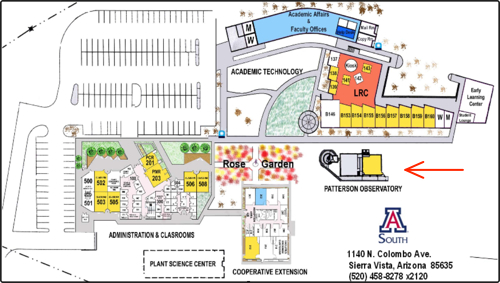
Guests bringing telescopes can drive to the rear (south side) of the observatory to drop off their equipment. See the map.
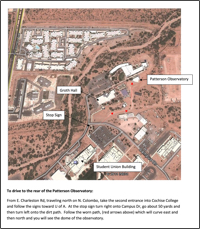 Click this document to show how to access
the rear of the Patterson Observatory.
HAC News
December 2014
The December Newsletter is Here!
A new issue of Nightfall, the official HAC newsletter, is now vailable! You can download
your December issue here!
December Announcements
Our meeting locations for 2015 vary, so please review the 2015 Schedule and events page in the newsletter.
The January meeting will be on the 2nd in the Student Union Building at Cochise College. We will be conducting another telescope clinic for the benefit of all those lucky recipients of shinny new telescopes.
Please remember when shopping at Amazon this holiday season to use the link to Amazon on the club's home page www.hacastronomy.com When you use that link, Amazon makes a generous payment to the club.
Please consider HAC membership as a holiday gift idea for that friend or family member that is interested in astronomy but has just never gotten around to joining.
And don't forget that it's time to renew your own membership for 2015. HAC memberships expire in December, so if you haven't renewed yet, please do so soon.
Star Party for December
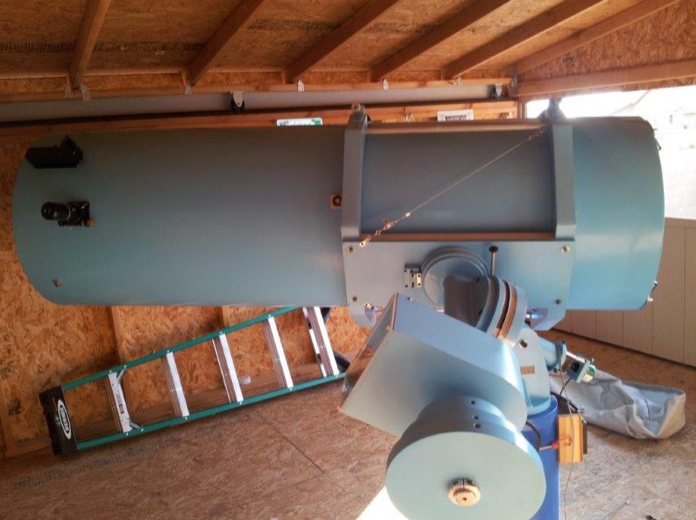
We would like to invite everyone up for a short notice club star party this Saturday Dec 20 at around 5:30 PM, since we did not have one scheduled this month. We finally have made all the adjustments on the 24-inch and it is working well now. We will also be plenty of snacks available so there is no need to bring anything.
We are located off of East Bevers and Highway 92. Turn east on Bevers from Highway 92 and continue for one mile. Continue past the stop sign on E Bevers and then turn left onto S Silver Lace Street. Turn right at the next street which will be E Lantana Dr and go to the end. We are located at the end of the cul-de-sac and on the left at 5515 E Lantana Dr. In the event of clouds or weather I will post a cancelation notice on the HAC List. If you have any questions please feel free to call me on my cell phone, at 559-760-3827. We hope to see everyone!
Gary and Aracelis Grue
5515 E Lantana Dr
Sierra Vista 85650
Cell 559-760-3827
HAC News
November 2014
The November Newsletter is Here!
A new issue of Nightfall, the official HAC newsletter, is now vailable! You can download
your November issue here!
Time to Renew Your Membership!
It is time again to renew your HAC membership for 2015. Thank you to everyone that renewed early! HAC memberships expire in December. You can mail your dues payment to HAC PO Box 922 Sierra Vista AZ or give your payment to the treasurer (Ted Forte) at the December pot-luck dinner or the January telescope clinic. You can also catch Ted at most outreach events. You can make checks out to HAC.
Know anyone that might enjoy a HAC membership? Please spread the word about the club and how to join. Have you ever considered giving a friend or family member a HAC membership as a holiday gift? Now is the perfect time.
$25 Regular Membership, $35 Family Membership, $20 Military, $25 Military Family, $10 Student
Meeting Announcement
The November meeting will be held at 7PM November 14 in the community room of the Student Union Building, Cochise College. Our speaker is Cindy LaRussa of TAAS. Cindy is a NASA Solar System Ambassador and her talk will feature some Discovery Program missions to explore the solar system.
HAC Events for 2015
If you want to plan ahead, you can download a copy of our 2015 HAC Events here.
A Letter from HAC Secretary Ted Forte
Dear HAC Member,
Special offer from SLOOH : Slooh is a Community Observatory with telescopes on the Canary Islands and in Chile that Slooh members can use remotely . As a special promotion, you can get a 90 day trial subscription to SLOOH by making a $30 donation to HAC. Go here: http://mbsy.co/slooh/12472135 and then click on "Astronomy Club Special Offer".
It's election time! November is the time for choosing officers for 2015. All club members are eligible to run for any of the 8 elected positions: President, Vice President; Treasurer, Secretary, and four member at large seats. The ninth member of the board of directors is the past president which is filled by the most recent available former club president. If you would like to serve our club as an officer or board member please contact one of the current board members: David Roemer, Chris Ubing, Ted Forte, Bob Hoover, Bert Kelher, Gary Grue, Wayne Johnson and Bob Gent.
Membership dues for 2015 are due in December but are accepted anytime. $35 family, $25 individual, military family $25, military individual $20, student $10 (non-voting membership). PLEASE RENEW.
Get your order in: I am taking orders for 2015 RASC Handbooks ($20 each) and the 2015 Astronomy Magazine Calendars ($6.50 each). I'll be placing the order after the October meeting. Please sign up at the meeting or let me know by email if you want to get in on these reduced prices.
The following members have signed up for RASC Handbooks: Forte, Kepple, Ubing, Johnson, Kelher, Snyder, Sanner, Gent (2), Hoover, Roemer (2), Whitesell, Duncan, Kreech, Gray and Grue.
The following members have signed up for calendars: Forte, Kepple, Kelher, Snyder (2) Gundy(2), Creech, Norquist, Raymond (2), Lund and Grue.
If you have not already paid for your order, please pay at the October meeting. You may also mail your payment to HAC, PO Box 922, Sierra Vista AZ 85636
Are you receiving the Reflector? Membership in HAC includes membership in the Astronomical League. You should be receiving the league's quarterly newsletter the Reflector . Please contact me if you are not receiving it so we can figure out why. The next issue of the Reflector will be the December issue.
One of the great benefits of league membership is the eligibility to participate in the A.L.'s observing program awards. I am the club's ALCOR/Awards coordinator. Please see me if you have any questions or need help getting started. Visit : http://www.astroleague.org/al/obsclubs/AlphabeticObservingClubs.html to see what programs are available.
HAS YOUR INFORMATION CHANGED? If you have recently changed your address, or phone number or would like to change the email that the club uses to contact you, please let me know.
Finally we urge all HAC members to sign up for HACLIST, our Yahoo e-group that we use for making announcements and scheduling events. Don't miss out on what is happening in your club. Send an email to [email protected] to sign up. You can select to receive individual messages, daily digests, special notices, or even no email.
Ted Forte
Secretary-Treasurer
HAC News
October 2014
The October Newsletter is Here!
A new issue of Nightfall, the official HAC newsletter, is now vailable! You can download
your October issue here!
HAC News
September 2014
The September Newsletter is Here!
A new issue of Nightfall, the official HAC newsletter, is now vailable! You can download
your September issue here!
Meeting Announcement
Our next meeting will be Friday September 12th at 7PM in the community room, student union building, at Cochise College. This month's meeting will feature a telescope clinic. A short presentation will deal with the operation of the basic types of telescopes and discuss some considerations when purchasing a first telescope. We have invited the public to bring in their telescopes for some individual help with set up, alignment and operation. That's where YOU come in. We need as many experts to attend as we can get. Please come prepared to share your expertise with our guests. Let's make some new friends, get some telescopes freed from those dark closets, and maybe enlist a few new members.
We will have a very special door prize at the September meeting but you must be present to win.
Inside you'll find some notices about my taking orders for the 2015 Astronomy Calendars and the 2015 RASC Observer's Handbooks. There will be signup sheets at the September meeting. Calendars are $6.50 each and you can pay for them at this meeting if you like. We won't know the price of the handbooks until the base price is announced and we see how many people sign up. Last year we paid $20 each and it should be in that ballpark again. We need to finalize the order by the November meeting. We will collect for the books in December and January.
I will also have Dine Under The Stars (DUTS) tickets. DUTS is 27 September. If you have signed up for tickets please come prepared to pay for them at the September meeting. Adult tickets are $40. The money goes to support the students, faculty and staff of the University of Arizona, South. It provides scholarships, merit awards and grants from the University South Foundation. The foundation owns and maintains the Patterson Observatory. I will have extra tickets available for sale at the meeting.
Hope to see you all at the meeting.
Ted Forte
Secretary-treasurer, HAC
HAC News
August 2014
Free Telescope Clinic in September!
The Huachuca Astronomy Club will offer a FREE telescope clinic at their September meeting on Friday, September 12 in the community room, Student Union Building, Cochise College 901 N. Colombo Avenue, Sierra Vista at 7pm. The telescope clinic is designed to help you understand how your telescope functions and help you master the process of aligning and using your scope. You can bring your own telescope to get some individual help or just come and learn the basics from the presentation. There will be a variety of telescope types on display. This is the perfect opportunity to learn how to choose the right telescope to put under the tree this December. The meeting is free and open to all. There will be a great door prize awarded too, but you must be present to win.
 Please use this flyer to spread the word!
Free Astronomy Class Starting in October!
The Huachuca Astronomy Club, along with the University South Foundation, Inc. are pleased to offer a FREE astronomy course at the Patterson Observatory this fall. Click for details!
The August Newsletter is Here!
A new issue of Nightfall, the official HAC newsletter, is now vailable! You can download
your August issue here!
Meeting Announcement
The Huachuca Astronomy Club will hold their next meeting on August 8, 2014 at 7PM in the community room, Student Union Building, Cochise College, 901 North Colombo Avenue, Sierra Vista. Guest speaker Richard Harshaw will relate the recent efforts of a team of astronomers and engineers to test and assess the pointing accuracy of the McMath-Pierce 0.8 meter East Auxiliary Telescope at Kitt Peak National Observatory. Their efforts uncovered procedures that achieve the requisite accuracy required to successfully use speckle interferometry. Speckle interferometry is an imaging technique that can alleviate atmospheric distortion to obtain greater telescope resolution than can otherwise be achieved. Mr. Harshaw is a member of the Saguaro Astronomy Club and a prolific double star observer that has contributed thousands of double star measurements to the Washington Double Star Catalog. He has several articles on double stars published in Journals and is the author of The Complete CD Guide To The Universe (Springer Publishing 2006). The meeting is free and open to the public.
HAC News
May 2014
Star Party for May
We would like to invite everyone again for a star party on Saturday, May 31 around 7:30 PM at our home. Hopefully we will have great weather this time and the clouds will stay away. We will have the 24-inch telescope available and if you have any objects that you would like to look at please feel free to bring a list. There will be plenty of snacks available along with soft drinks.
We are located off of East Bevers and Highway 92. Turn east on Bevers from Highway 92 and continue for one mile. Continue past the stop sign on E Bevers and then turn left onto S Silver Lace Street. Turn right at the next street which will be E Lantana Dr and go to the end. We are located at the end of the cul-de-sac and on the left at 5515 E Lantana Dr. In the event of clouds or weather I will post a cancelation notice on the HAC List. If you have any questions please feel free to call me on my cell phone, at 559-760-3827. We hope to see everyone!
Gary and Aracelis Grue
5515 E Lantana Dr
Sierra Vista 85650
Cell 559-760-3827
Saturday, May 10th is Astronomy Day!
Don't forget that this Saturday is ASTRONOMY DAY at the Sierra Vista Library. All HAC members are encouraged to participate in this most special of outreach opportunities. Come help bring astronomy to the people of Sierra Vista. Bring a scope if you can, but even if you just stop by for a short stay, please plan to be a part of this world-wide effort to promote our hobby and the science that fuels it. I hope to see you there! The festivities start around 10am - set up starts at 9. The event will run until late afternoon.
Club Treasurer Needed!
Our treasurer, Tommy Neyhart needs to step down immediately. The office of treasurer is the most important function on the club's board of directors. The club simply can't function without one. Most of the work for the year is done; however, a fill-in treasurer can pretty much coast to the next election. Collecting dues from new and renewing members and keeping tabs on the bank statement is most of what will be required. The treasurer should be able to make all of the general meetings and attend whatever board meetings are called (as often as one additional meeting per month). The treasurer also traditionally serves as the Astronomical League Correspondent (and awards coordinator) as well, but I can help you with that.
Can you answer the call? If you can assume the duties of the treasurer please contact David Roemer or me.
Ted Forte
Secretary, Huachuca Astronomy Club
May's Newsletter is Here!
A new issue of Nightfall, the official HAC newsletter, is now vailable! You can download
your May issue here!
Meeting Announcement (Temporary Location Change!)
The May meeting of the Huachuca Astronomy Club will be held at THE PATTERSON OBSERVATORY. The observatory is located on the campus of the University of Arizona South, Sierra Vista. Parking is available in the UA South parking lot on the east end of the campus. Restrooms are available in the building behind the observatory near the Early Learning Center. There will be seating for a presentation in the Patterson Observatory classroom and everyone will get the chance to look the telescope over and view a few celestial splendors if you like. The meeting will be at the usual time - 7PM on Friday May 9.
There will be a meeting of the HAC board of directors in the observatory before the meeting, beginning at 6PM. As always, the BOD meetings are open to the public and all members are welcome to attend.
HAC News
April 2014
Earth Day in Sierra Vista
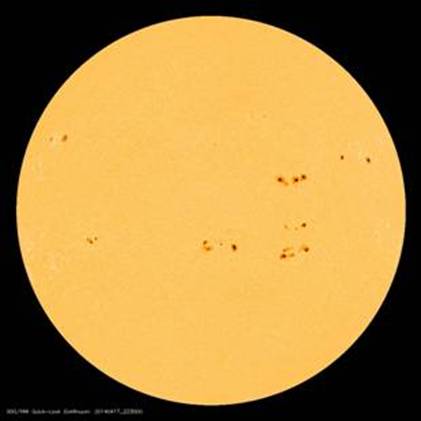
Sierra Vista will celebrate Earth Day on Thursday, April 24, 2014 in Veterans Memorial Park. The Huachuca Astronomy Club will be setting up solar telescopes from 10 am to 2 pm in concert with the Farmer's Market. The sun is nearing a solar maximum, and this means we should see more sunspot activity (see image below from NASA's SOHO Spacecraft, April 17). In addition, we will have a loaner meteorite kit from the Planetary Science Institute in Tucson. We will also have handouts from the International Dark-Sky Association, and one of NASA's Solar System Ambassadors with be there, too. Get a chance to see the sunspots and prominences close up through specially filtered telescopes. This event is free and open to everyone.
Star Party for April
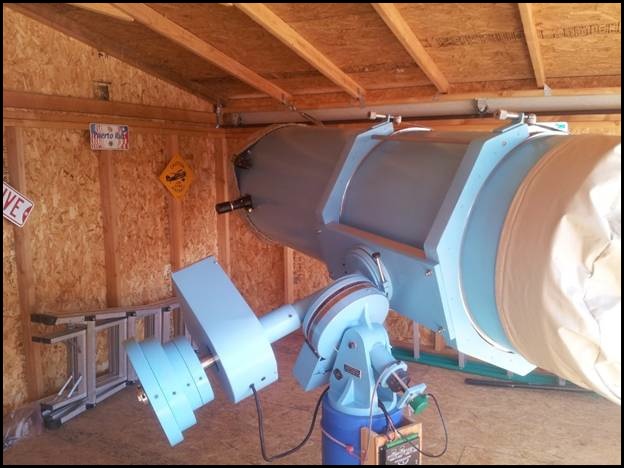
We would like to invite everyone for a star party on Saturday, Apr 26, around 7:30 PM at our home. We have finally got all the final adjustments done on the scope thanks to Tom Kaye along with help from Max Mirot and Ted Forte and will have the 24-inch telescope up and running. We will also have snacks available along with soft drinks. Please dress warmly just in case since even with the warm days the night temperatures can drop quickly.
Again we are located off of East Bevers and Highway 92. Turn east on Bevers from Highway 92 and continue for one mile. Continue past the stop sign on E Bevers and then turn left onto S Silver Lace Street. Turn right at the next street which will be E Lantana Dr and go to the end. We are located at the end of the cul-de-sac and on the left at 5515 E Lantana Dr. There should be plenty of parking available on the cul-de-sac. In the event of clouds or weather I will post a cancelation notice on the HAC List. Please feel free to call me on my cell phone, at 559-760-3827, if you have any questions. We hope to see everyone!
Gary and Aracelis Grue
5515 E Lantana Dr
Sierra Vista 85650
Cell 559-760-3827
Meeting Report for April
|
Our speaker this month was University of Arizona Planetary Science PhD candidate Rob Zellem. The night's talk was titled "Finding Life in the Galaxy".
Rob Zellem is a 4th year PhD candidate at the University of Ari zona's Lunar and Planetary Laboratory. His love for astronomy and planetary science began at a very early age with multiple viewings of Star Wars and when he would look up to the night sky and wonder "are we alone?". In order to find extraterrestrial life, he received his Bachelor of Science in Astronomy & Astrophysics from Villanova University in 2008 and his Masters of Science in Space Science from University College London in 2009. Since 2010, he has been studying transiting exoplanets at the Lunar and Planetary Laboratory. Using observations from both ground and space-based platforms, he determines the thermal structure and molecular abundances of these extrasolar planets. After graduating with his PhD in May of 2015, he aims to work at a NASA center to help develop future space missions to better characterize these interesting objects.
Rob's talk was often humorous and wonderfully educational. Of the many ways exoplanets are detected, he focused on two: Radial Velocity and Transit Method. More details on these and the rest of the methods
can be found in this Wiki article.
|
 |
HAC News
January 2014
Help Keep the Electronic Sign Ban in Place!
The ban on electric advertising signs has reappeared at the City Council. The Mayor and Council members are looking to eliminate the ban. Many concerned HAC members and Arizona citizens have written letters and attended Council meetings to voice their opinions on this particular piece of legislation. If you are not well versed in light pollution issues, please see our special section of the website dedicated to this growing problem. We have also started to collect some letters being sent to the Mayor. These letters are very enlightening and we encourage everyone to read them and become familiar with the topic. We hope these letters inspire you to get involved, write your own letters, and help us protect our night skies!
First Star Party of 2014!
We would like to invite all club members to a member star party on Saturday, Jan 4, around 6:00 PM at our home. We will have the old Celestron 14 telescope set up as a Hyperstar imager to putz around with in the Explora-Dome, a Meade 8 on the back porch and a set of 25x100 Binocs on the deck. You are also welcome to bring your own scope (you know the big one you got for Christmas) if you like because we have the space (and, I'd like to see what an 18" Obsession would do off the back porch) and power is available. We will also have snacks available along with tea and coffee.
Dress warm cuz, "baby it's cold outside."
We are located at 4659 South Shoshoni Av. We'll have a red light on at the front door. There should be plenty of parking in the driveway In the event of cloudy or snowy weather, we will post a cancelation notice on the HAC List and just show a space themed movie instead. Please feel free to email or call me on my cell phone, at 408 771-3572, if you have any questions. We hope to see everyone!
David Roemer and Nancy Hannaford [ Contact: 408 771-3572 or david_roemer (at) earthlink.net ]
Sky Calendar for 2014!
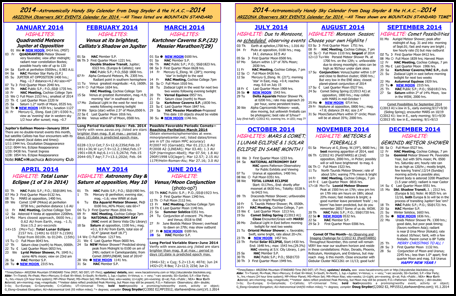
Doug Snyder has released an all new edition of his Sky Calendar for 2014! You can click the image below to download your free PDF copy! This calendar is so packed with information it took two sheets this time! New moons, asteroids, comets, HAC events, it's all on there and MORE! Grab yours today! Be sure and give Doug a big thank you when you see him!
 Click to Download! Click to Download!
Meeting Announcement for January
|
Our January guest speaker will be Dr. Vishnu Reddy from the Planetary Science Institute in Tucson, Arizona. His research focuses on asteroids, meteors, and meteorites in the Solar System. Some asteroids are perturbed from their orbits in the Main Asteroid Belt to become near-Earth objects (NEOs), which have the potential to impact the Earth and cause catastrophic damage to life and property. A majority of this thesis work was done using the NASA Infrared Telescope Facility on Mauna Kea, Hawaii. Prior to graduate school, he participated in an astrometric survey as an amateur astronomer discovering 23 new Main Belt asteroids and improving orbits of 1000s of other asteroids. Currently, Dr Reddy's primary focus is surface composition of asteroids. Dr Reddy is also member of the Framing Camera (FC) team on NASA's Dawn mission to asteroids Vesta and Ceres. Dr Reddy received his PhD in Earth System Science from the University of North Dakota, Grand Forks, with the thesis "Mineralogical Survey of Near-Earth Asteroid Population: Implications for Impact Hazard Assessment and Sustainability of Life on Earth."
Asteroid (8068) Vishnureddy was named by the International Astronomical Union after Dr Reddy.
The January meeting will be held on January 10th at 7pm, in the science lecture hall, room 1110 of the science building of Cochise College.
The title of Vishnu's talk will be: NASA Dawn Mission to Dwarf Planet Ceres: Opportunities for Amateur Astronomer
|
 |
HAC News
December 2013
HAC Christmas Party a Success!
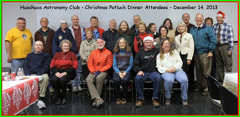
Many thanks to all those who participated in this year's Christmas Party! The food was great and the company was delightful. Thanks to Doug Snyder for acting as photographer for the event. Ted also snapped some pictures and posted those to our Yahoo mailing list. You can see Ted's photos here.
 HAC Christmas Party is Almost Here!
|
You are invited to the Huachuca Astronomy Club's holiday potluck get together next Saturday, December 14, 2012 at the Patterson Observatory. 5:00 pm until about 7 pm. All members and friends are invited to attend.
We'd like to coordinate what people bring. (We don't want twenty bowls of macaroni salad now do we?) If you can bring a dish to share please sign up on the database on the haclist web site here:
http://groups.yahoo.com/neo/groups/haclist/database/2/records
If the link doesn't work, just click on "database" from the "More" drop down menu of this group's homepage:
http://tech.groups.yahoo.com/group/haclist/
then on the Pot luck database, then click "Edit Table".
If you have trouble , just reply to me (tedforte511 at gmail.com). I need to know how many in your party and what you intend to bring. If we already have it coming, I'll get back to you.
Let's share a fun time together to kick off the holidays and bring in the new year. I hope to see you there!
The Patterson Observatory is located on the campus of the University of Arizona, South adjacent to the Cochise College campus in Sierra Vista. You can find maps and driving directions here.
- Ted Forte
|
 |
Congrats to our 2014 Board of Directors!
Congratulations to our HAC members who have stepped forward and answered the call to serve on the 2014 Board of Directors! Taking
effect as of 1 December, the new board consists of:
President: David Roemer
Vice President: Chris Ubing
Secretary: Ted Forte
Treasurer: Tommy Neyhart
Past President: Bob Gent
Members at Large:
Doug Snyder
Bob Hoover
Gary Grue
Bert Kelhe
Many thanks to past board members for their service to the club! We look forward to supporting our new board in 2014!
HAC News
November 2013
November's Newsletter is Here!
A new issue of Nightfall, the official HAC newsletter, is now vailable! You can download
your November issue here!
Meeting Announcement for November
Our next meeting will be held on November 22nd at 7pm, in the community room of the Student Union Building at Cochise college. Scott Kardel, Managing Director of the Tucson-based International Dark-Sky Association, will present "Light Pollution: Perspectives from Earth and Space" --an engaging visual look at the problems of light pollution. Scott will show dramatic still and time-lapse imagery captured from the International Space Station, including nighttime views of Tucson and Phoenix from space. This perspective provides a new and revealing look at how the glow of our city lights wastes energy and impacts astronomy along with the natural world.
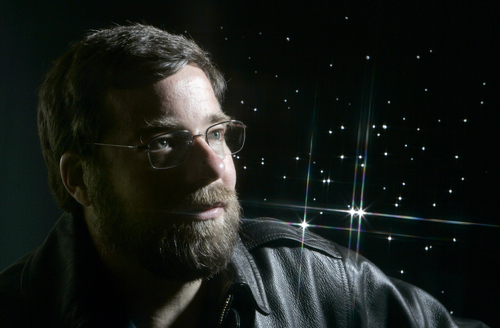
Scott Kardel is the Managing Director of the Tucson-based International Dark-Sky Association. Scott is a native of Tucson, AZ. He has a Bachelor's Degree from Northern Arizona University and taught high school science in Arizona for nine years. After completing a Master's Degree in astronomy from the University of Arizona, Scott took his passion for the stars to Kansas, where he served as assistant director for the Lake Afton Public Observatory. Prior to coming to International Dark-Sky Association, Scott served for eight years as the public affairs coordinator for Palomar Observatory. He directed their public outreach program and was the observatory's representative on light pollution issues.
Please come and join us for this amazing and educational presentation!
Star Party Location for November
"We would like to invite all club members to a member star party on Saturday, Nov 2, around 6:00 PM at our home. We will have the 24-inch telescope available for viewing. You are also welcome to bring your own scope(s) if you like and power is available. We will also have snacks available along with soft drinks. Please dress warmly since as you know the fall nights do cool off rapidly.
We are located off of East Bevers and Highway 92. Turn east on Bevers from Highway 92 and continue for one mile. Continue past the stop sign on E Bevers and then turn left onto S Silver Lace Street. Turn right at the next street which will be E Lantana Dr and go to the end. We are located at the end of the cul-de-sac and on the left at 5515 E Lantana Dr. There should be plenty of parking available on the cul-de-sac. In the event of cloudy or rainy weather, we will post a cancelation notice on the HAC List. Please feel free to call me on my cell phone, at 559-760-3827, if you have any questions. We hope to see everyone!"
Gary and Aracelis GrueCell 559-760-3827
You can check out pictures of Gary's Blue Marvel Obervatory here and find a map here.
HAC News
October 2013
Location Change for October Meeting!
Due to circumstances beyond our control, the HAC Monthly Meeting will not meet in the usual location and will instead convene in Room 1101 (Physics Room) on the Cochise College campus.
October's Newsletter is Here!
A new issue of Nightfall, the official HAC newsletter, is now vailable! You can download
your October issue here!
2014 HAC Board of Directors Election Information
HAC has a new president! Kim Roglaski, who was serving as interim president, had to step down due to his overwhelming work load in his day job. The HAC Board of Directors appointed David Roemer to serve as president until the election next month. David is a 2014 candidate for HAC president. Remember, the election of officers will take place at the November meeting. So far we have a full slate of candidates, but only one candidate has been identified for each office and as it stands the election will be held by affirmation. It is not too late to announce your desire to serve in an office. Any position that has two or more candidates, will be filled by a regular (ballot) election. See http://www.hacastronomy.com/constitution.htm for a description of officer duties and the prescription for holding elections. Interested candidates should make their availability known to our nomination committee members Bert Kelher or Gary Grue.
The candidates for the 2014 board of directors:
David Roemer for President
Chris Ubing (incumbent) for Vice President
Ted Forte (Incumbent) for Secretary
Tommy Neyhart for Treasurer
Doug Snyder (Incumbent) for Member at Large
Bob Hoover (Incumbent) for Member at Large
Gary Grue  for Member at Large
Bert Kelher for Member at Large
Meeting Annoucement for October
Our next meeting is October 25, 2013. The meeting will be held in Room 1101 (Physics Room), Cochise College at 7:00 PM. HAC member Jeff Ofstedahl, also known as "Mr. Oh!" is the speaker. Jeff is the science director at the Center for Academic Success, a National Science Foundation fellow and NASA Education Ambassador. His presentation is about NASA's next mission to Mars, the MAVEN mission scheduled to launch Nov. 18th. Learn about the connection between Mars' magnetic fields and the loss of its atmosphere: Could it happen to Earth?
HAC News
September 2013
HAC Board Elections for 2014
In November, we will hold elections for officers and the board of directors. This year we have to fill three positions that will be vacated by the incumbents. The office of president, the office of treasurer and one 'at large' seat on the board of directors needs to be filled. While the incumbents in the other positions are willing to continue to serve, nominations for ANY office can be made. If you have a willingness to serve in a position on the board, please make it known to our nominating committee. You can reach Bert Kelher at 520-508-1535 or Gary Grue at 559-760-3827 . You can find HAC's governing documents here. The duties of the officer positions and the methods for nominating and electing of officers are spelled out in our club Constitution and by-laws.
September's Newsletter is Here!
A new issue of Nightfall, the official HAC newsletter, is now vailable! You can download
your September issue here!
Dine Under the Stars
September 28 is Dine Under The Stars, the major fundraiser for the University South Foundation. HAC members will support the event by opening and operating the Paterson Observatory. All members are invited to assist at the observatory.
October Star Party at Kartchner Caverns
October 5 is the Kartchner Star Party at Kartchner Caverns State Park. We will join with members of the Verde Valley Astronomers and other amateurs from around the state to support this outreach event. Members are encouraged to set up for solar observing in the afternoon. At 5:30, there will be talk at the visitors center by Steve Kortenkamp, an astronomer at the Planetary Science Institute in Tucson. And then deep sky observing after dark.
October Astronomy Day Celebration
We will celebrate Astronomy Day on Saturday, October 12 at the Patterson Observatory. All members are invited to participate. We will be setting up to do solar observing at 1PM. There will be a break from 4PM to 7PM when we will reconvene for night time observing. It is also "International Observe the Moon Night" and the first quarter moon will present quite a target.. Come on out and help us "Bring Astronomy to the People"
HAC News
August 2013
Meeting Annoucement for August
Our next meeting will be held on August 23rd at 7pm, in the community room of the Student Union Building at Cochise college. There will be a presentation by Mr. Chris Ubing, the astronomy instructor at Cochise College. He will demonstrate planetarium software that can be used either with a computer, IOS or Android technology. The growing presence of smart phone technology allows us to demonstrate concepts in astronomy on computers and smart phones. During this presentation, he will give a review of some of the more common packages and how they may be used to enhance observations of the heavens and demonstrate concepts.
August's Newsletter is Here!
A new issue of Nightfall, the official HAC newsletter, is now vailable! You can download
your August issue here!
Meeting Annoucement for July
Our next meeting will be held on July 26 at 7pm, in the community room of the Student Union Building at Cochise college. Our own Tom Kaye will be the speaker.
Tom's talk is entitled Dinosaurs, Gamma Ray Bursts and Mass Extinctions.
Although it is well established that the Chicxulub impact occurred at the end of the dinosaur's reign, many paleontologists are not comfortable with that scenario because it does not explain some of the unusual patterns of extinction. Strangely all land animals over 50 lbs died while small animals survived. In the oceans smaller surface dwellers like the plankton died but deeper dwelling animals survived. Gamma ray bursts are extremely powerful explosions capable of wiping out life on a planet if they were close enough. GRB's are relative newcomers to the astronomy scene and this talk will examine the links between GRB's and extinctions that could explain the pattern of extinctions and STILL involve a bolide impact.
Tom Kaye is a paleontologist with the Burke Museum in Seattle and leads the Spectrashift Exoplanet Search Project. He is the only person that is a member of both the Society of Vertebrate Paleontologists and the American Astronomical Society giving him a unique view on this subject. He spends summers in the field hunting dinosaurs and winters running a large astronomical telescope. His work can be seen at tomkaye.com.
July's Newsletter is Here!
A new issue of Nightfall, the official HAC newsletter, is now vailable! You can download
your July issue here!
COMET ISON is A-Coming!
I am hoping to be able to post and have a weekly
email countdown with updates on the HAC-List so that we all can keep abreast
of its travels. This is going to be HUGE later this year (one way or
another), and I do not feel we should just drop the subject until that time.
With these updates, I plan on including orbital information, the latest
images from NASA or Earth based observatories, including ours, and more! Do
you know what ISON means? It is, "International Scientific Optical Network",
but the comet was discovered via CCD imaging by two Russian astronomers in
September 2012.
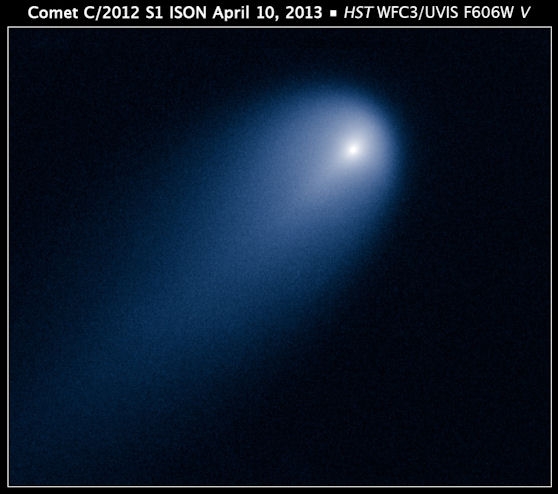
A little further down the page, there is a link to some of the very latest
information on Comet ISON from NASA. This comet is INBOUND to the inner
Solar System, and will be making its closest approach to the Sun on
ThanksGiving Day 2013 - November 28th. That approach distance is currently
estimated to be within 1,100,000 miles from the surface of the Sun. After
(hopefully) surviving that passage very close to the Sun, the comet will
then have its closest approach to Earth on December 26, 2013 (0.427 AU, or
39.7 million miles). Currently, the comet is moving between the orbits of
Jupiter and Mars, and is expected to cross the orbit of Mars in early
October, and then cross the orbit of Earth in early November.
Click this link for more ISON details direct from NASA's webiste!
NASA has also recently launched another great informative web site, with
fact packed blogs that relate directly to Comet ISON, and these are titled:
CIOC, or Comet Ison Observing Campaign.
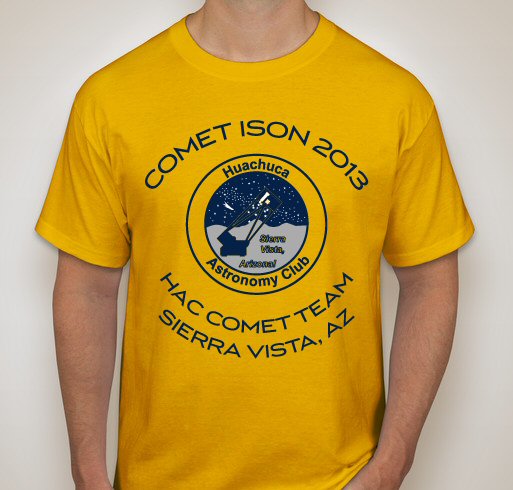
At the last HAC meeting at the end of June, a good number of Comet ISON /
HAC logo T-Shirts were purchased (at a very reasonable cost), and although
we ran short of a few sizes, those have been replenished for the July
meeting on July 26 - so if you are a member, but don't have one (or more),
here's another chance to get an historic T-Shirt from HAC ! We will try to
keep these in stock until later in 2013, but get yours before its too late!
Guys, Gals, and Youth.
Be sure to join the HAC List to get Doug Snyder's latest updates on our new comet friend! Sign up HERE!
HAC News
April 2013
April Nightfall is here!
A new issue of Nightfall, the official HAC newsletter, is now vailable! You can download
your April issue here!
Meeting Annoucement for April
Our speaker for the April 26th meeting will be Dolores Hill, Sr. Research Specialist at the Lunar & Planetary Laboratory, The University of Arizona. Her talk is titled "Meteor Falls...Far and Near: Meteorites from Chelyabinsk, Russia and Whetstone Mountains, Arizona"
We will be hosting Dr. Hill at the Outback Steak House in Sierra Vista for dinner before the meeting. We'll make reservations for 5:00 PM.
All members and friends of HAC are invited to join us at the dinner. Please let me know as soon as possible if you will be able to attend so we can make adequate arrangements for seating. You can contact Ted Forte at twforte(at)powerc.net.
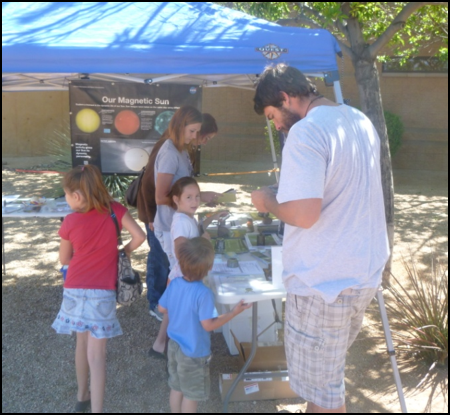
Astronomy Day 2013 a Success!
Many thanks to all of the HAC volunteers who came out and supported this community outreach project! Specal thanks to Tommy Neyhart for leading the charge and making this event happen. Ted Forte
has provided some pictures of the event that are now on display in the HAC Event Gallery, so check them out! Send your photos to webmaster(at)hacastronomy.org if you would like them included in the gallery.
Astronomy Day is almost here!
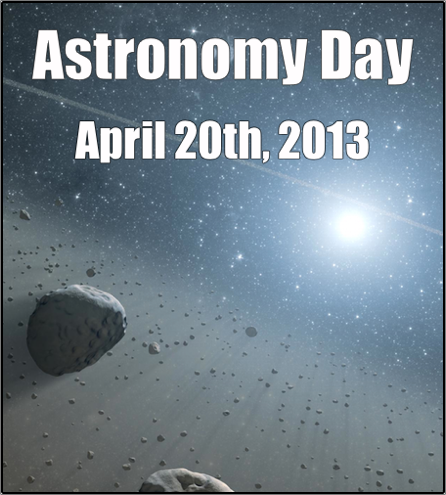
This years Astronomy Day activities will be taking place at the Sierra Vista Public Library on Saturday, April 20th. There will be solar telescopes setup
outside at 10 AM and more astronomy related displays indoors. There will also be a 1000 yard (3000 feet) scale model of the Solar System on display outside. Everyone is welcome to attend and bring their friends, family, and neighbors!
Help us spread the word by displaying these Astronomy Day flyers around your workplace!
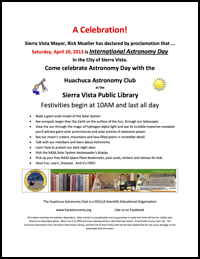
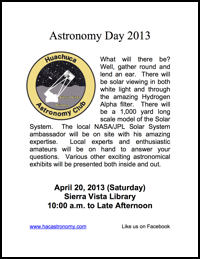 We hope to see you there!
Public Night at the Patterson Observatory
The Patterson Observatory and the Huachuca Astronomy Club invite you to a public viewing of the
night sky on Thursday, April 18, at about 7:20 PM. Weather permitting, you will be able to
view the heavens with the 20-inch Patterson Telescope and other instruments. Among possible sights
are craters of the crescent moon, gas giant planets Uranus and Neptune, double stars, various star
clusters, nebula, planetary nebula and distant galaxies. This free event is open to all. The
observatory is located at 1140 N. Colombo Dr., on the University of Arizona South campus, just east
of Cochise College. A map is available here.
HAC News
March 2013
March Nightfall is here!
A new issue of Nightfall, the official HAC newsletter, is now vailable! You can download
your March issue here!
Comet PanSTAARS Visible in the West
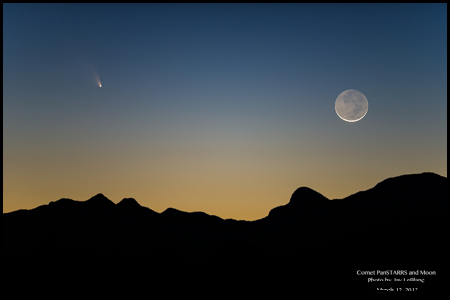
HAC club member Jay LeBlanc snapped this amazing photo of comet PanSTARRS (C/2011 L4) above the Huachuca mountains.
From the Wiki article linked in the name:
"Comet C/2011 L4 probably took millions of years to come from the Oort cloud. After leaving the planetary region of the Solar System, the post-perihelion orbital period (epoch 2050) is estimated to be roughly 106000 years."
Kartchner Caverns Star Night in March
March 16 is the big day for Kartchner Caverns astronomy, and the weather forecast is looking good. Dr. Tim Hunter will be the guest speaker at Kartchner Caverns star night starting at 5:30 pm in the Discovery Center. Among his many other notable achievements, he is the president and co-founder of the International Dark-Sky Association. His talk will include the a discussion and photographs of wonders of the night sky and preservation of our heritage of dark skies. Starting around 1 pm or so, we will have solar telescopes set up. Lunt Solar Telescopes will be joining us from Tucson, and they will be using some fine instruments. Starting at about 6:30 pm we will have telescopes set up in the bus parking area for public viewing of the night sky. We hope to see you there!
March Meeting Announcement
The next meeting of the Huachuca Astronomy Club will be on Friday, March 22 at the Cochise College, Sierra Vista campus. The meeting will be held in the community room of the student union building at 7 pm. The guest speaker will be Dr. Janine Pforr of the National Optical Astronomy Observatory in Tucson, AZ. The title of her talk will be "The Property of Galaxies." The Universe is filled with billions of galaxies of all shapes and sizes. Deep surveys such as the Hubble Deep Field have shown us however, that galaxies in the early Universe look significantly different compared to those we observe today. Dr. Pforr studied for her undergraduate degree in Physics at the University of Heidelberg, Germany, before moving to Portsmouth, UK, to obtain her PhD. We will be awarding astronomical door prizes, and this meeting is free of charge and open to the general public.
Messier Marathon Plans for April
The Messier Marathon has been changed to April 6th at the Observatory of Bob & Barb Kepple in Hereford.
Snacks, Coffee, Tea, and Hot Coca will be provided. If you can't stay all night come for as long as you want.
The 22-inch will be up and running but if you plan to observe all the Messier Objects you may want to bring your own
scope. We have a few power outlets if needed but bring your own extensions.
Sunset is 6:43 pm on April 6th. Astronomical Twilight ends at 8:06 pm. A crescent moon rises at 4:12 am which
shouldn't interfere with getting the last few objects. If bringing a scope allow yourself enough time to set up
before dark and you may drive around to the backyard beside the observatory. If you need directions check the HAC web
site or phone 520-366-0490.
Hoping for clear skies,
Bob & Barb Kepple
Sky Calendar Update for March
Hi - Here is the SkyCalendar (Arizona) Update for March 2013; Thanks for visiting!
The previously published March HighLite (Messier Marathon) on 09 March has been changed
to : optional MM at the Blue Marvel Observatory (Gary Grue) and Member Star Party.
Another MM, and MSP date has been set for Saturday, April 6, at Bob & Barb Kepple's
observatory in Palominas, which is named: Desert Starlight Observatory (DSO).
Update on March astronomical events:
Comet Pan-STARRS (C/2011 L4): As of the last day of February, this comet is still
only visible from the southern hemisphere. But in early March, it should become visible
for folks in the northern hemisphere low in the western skies after evening twilight. On
March 5, it will reach its perigee point (closest to Earth) at just over 1 AU
(Astronomical Unit), and on March 10 (UT) it will pass closest to the Sun (perihelion) at
around 0.30 AU ! If it survives that milestone, it should be quite visible for northern
observers from March 12 to March 17. Also in early March, it MAY reach magnitude -0.2 and
then begin to fade. Many questions still have to be answered about its perihelion
passage. Both Sky & Telescope magazine and Astronomy magazine have more articles on
this comet, and on their websites.
Comet Lemmon (C/2012 F6): The comet is currently coursing its way on the Tucana
the Toucan constellation. Not visible in the northern hemisphere - unfortunately.
Monday, March 11 (1251 hrs, MST): New Moon, start of Lunation #1116
Thursday, March 14: Public Astronomy Night at Patterson Observatory in Sierra
Vista" Sunset is at 6:29 pm; Come on out and observe or assist!
Saturday, March 16: BIG Astronomy Night at Kartchner Caverns State Park; this gets
underway in the afternoon with Solar Viewing, but there is also an 'astro' talk in the
early evening, and great dark sky viewing in the evening! Bring the family and a
telescope and join other members of the HAC and other clubs, out under the stars.
Sunday, March 17: The Moon and Jupiter get close (about 1.4 degrees) at around 7
pm. This should be a pretty sight.
Wednesday, March 20: Vernal Equinox, 4:02 am (0402 hrs. MST); Spring starts in the
northern hemisphere.
Friday, March 22: The HAC monthly meeting, starts at 7 pm; at Cochise College.
Sunday, March 31: Easter Sunday
A free star map for March, 2013 can be downloaded at http://www.skymaps.com/downloads.html
From Dave Mitsky's great blog (found at "Cloudy Nights Telescope Reviews"):
"Saturn retrogrades through Libra this month. The tilt angle of its rings during March is
19 degrees. Its equatorial diameter is 18.3 arc seconds at midmonth. Saturn rises at
11:00 p.m. local time and transits the meridian at 4:00 a.m. local time at midmonth. The
waning gibbous Moon passes three degrees south of the Ringed Planet during daylight on
March 2 and March 29. Click on http://www.curtrenz.com/saturn for a wealth of information
on Saturn. Eight-magnitude Titan is positioned north of Saturn on the nights of March 12
and March 28 and south of the planet on March 4 and March 20. Iapetus is nine arc minutes
from Saturn when it reaches greatest western elongation on March 13."
As Always, the night sky is so magnificent to explore and to discover. How many of the 88
constellations can you remember to name - and view?
Comments and suggestions always welcome !!
Until next month - Clear Skies, Doug Snyder
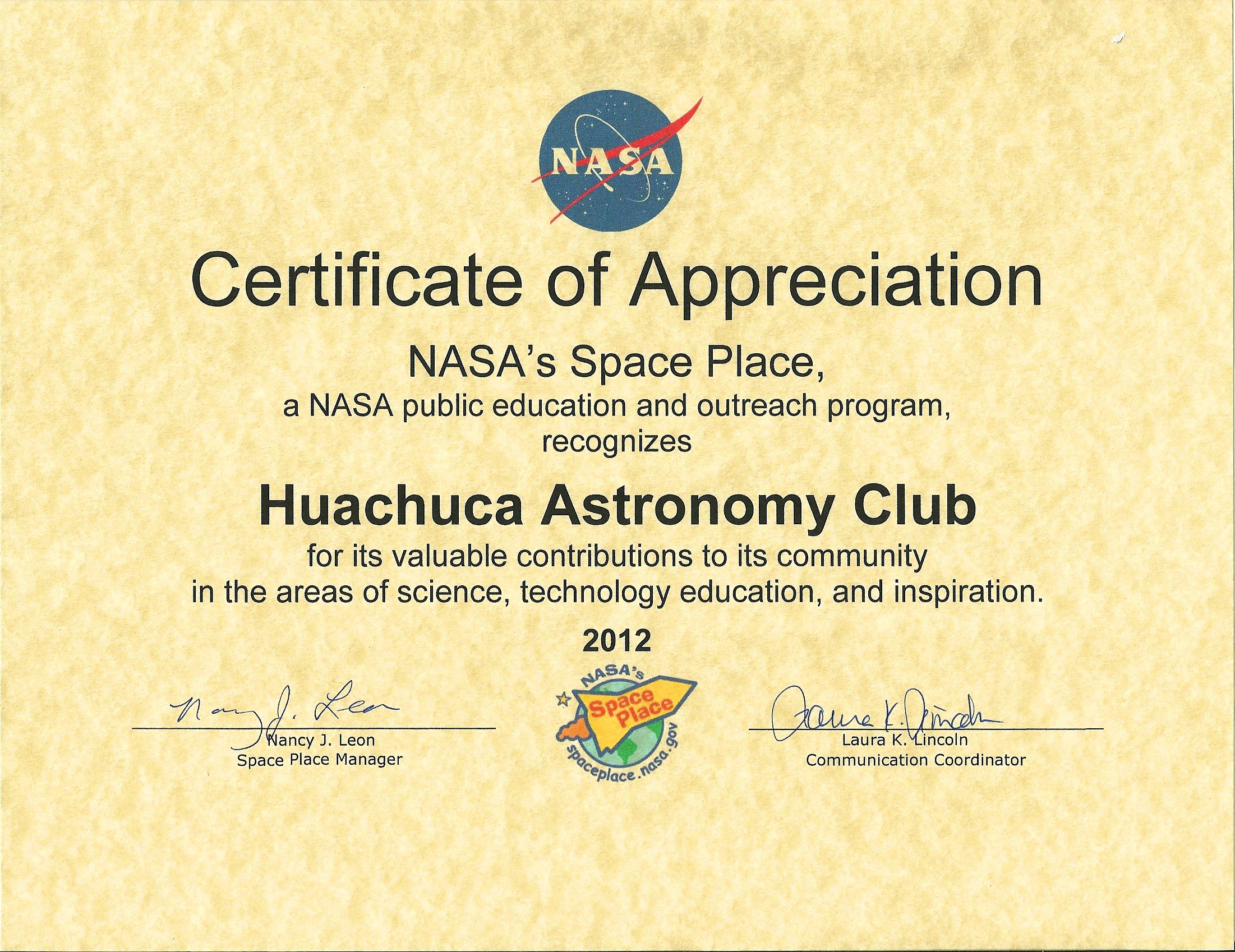
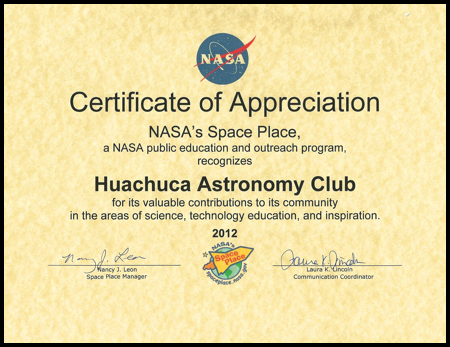
HAC Gets Recognition by NASA/JPL!
The NASA Space Place, an education and outreach program of NASA's Jet Propulsion
Laboratory, has recognized the Huachuca Astronomy Club of Southeastern Arizona in a
Certificate of Appreciation. The certificate acknowledges the club's "valuable
contributions to its community in the areas of science, technology education, and
inspiration".
HAC News
February 2013
February Meeting Announcement
The next meeting of the Huachuca Astronomy Club will be on Friday, February 22 at the
Cochise College, Sierra Vista campus. The meeting will be held in the community room of the student
union building at 7 pm. The guest speaker will be Mr. Bob Kepple, an Astronomical
League Master Observer, and a noted author of astronomy guidebooks. Mr Kepple will be sharing some
of his magnificent night sky photography taken from his observatory in Palominas. We will be
awarding one of Mr Kepple's signed Night Sky Observer's Guide, volume two as a door prize. In
addition, HAC President Bob Gent will give an update on Near Earth Objects, and he will cover the
history of past asteroid collisions with Earth. This meeting is free of charge and open to the
general public.
February Nightfall is here!
A new issue of Nightfall, the official HAC newsletter, is now vailable! You can download
your February issue here!
HAC News
January 2013
January Meeting
Announcement
The next meeting of the Huachuca Astronomy Club will be on Friday, January 25 at the Cochise
College student union building at 7 pm in Sierra Vista, AZ. The guest speaker will be Dean
Ketelsen. Dean works at the University of Arizona's Mirror Lab where they are constructing new
8.4 meter diameter mirrors for the Giant Magellan Telescope. He is also working on a unique mirror
for the Large Synoptic Survey Telescope. In addition, Dean has worked at the Kitt Peak National
Observatory, and he is a past officer of the Tucson Amateur Astronomy Club. Dean is also an
accomplished astrophotographer, and he will share his latest astronomical photos and news with us.
We will be awarding a signed Night Sky Observer's Guide, Volume One as a door prize. This meeting is
free of charge and open to the general public.
Public Night at the
Patterson Observatory
The Patterson Observatory and the Huachuca Astronomy Club invite you to a public viewing of the
night sky on Thursday, January 17, at about 6:15 PM. Weather permitting, you will be able to
view the heavens with the 20-inch Patterson Telescope and other instruments. Among possible sights
are craters of the crescent moon, gas giant planets Uranus and Neptune, double stars, various star
clusters, nebula, planetary nebula and distant galaxies. This free event is open to all. The
observatory is located at 1140 N. Colombo Dr., on the University of Arizona South campus, just east
of Cochise College. A map is available here.
Sky Calendar Events for January 2013
Hi! Have you downloaded the FREE 2013 SkyCalendar yet? If so, what follows is the January 2013
updates; if not, please scroll down the page and select to download the 2013 calendar in PDF; I
don't think you'll regret it (if you do, please let me know why!). Both the calendar and the monthly
updates are posted on two web sites; one is the Huachuca Astronomy Club's well known 'hacastronomy
dot com' and my sky-calendar blog at http://skycalendar.blackskies.org
We love the Starry Nights ! Let us look forward to the new month and year and think 'positive'
about all of the observing under clear skies where-ever you are! 2013 may turn out to be a banner
year, and let us discover the night sky together! Keep in mind that the times shown here in these
updates are for MST (Arizona) and NO Daylight Savings Time.
EXISTING JANUARY 2013 CALENDAR EVENTS - EXPANDED REMARKS
Highlites:
With a waxing Moon (at about 70% illumination) rising on Monday, 1/ 21, Jupiter and the Moon can be
as close as less than 1 degree in the evening at about 8 pm, one of the closest Moon-Jupiter
conjunctions of the year! Also look for the star Aldebaran below the pair.
In the dawn sky, and in western Libra, Saturn, at a distance of about 10 astronomical units, is
really looking fine! The northern side of the rings is very visible this year, and their tilt
relative to Earth, for most of the year, remains at 18 deg; much later in the year, this tilt
increases to over 20 deg. Catch the January views of the shadows on the globe and the 3D effect of
the rings. Stunning!
Updates (as necessary) For Listed Calendar Events for January, 2013:
1) Quadrantids Meteor Shower: Thursday morning, January 3rd. Severe waning gibbous Moon
interference for this sometimes quite active major shower. Named after a extinct constellation
"Quadrans Muralis (The Mural), which is now incorporated into northern Bootes.
2) HAC Member Star Party: Saturday, January 12th. As of this writing (late December, 2012), this
star party is scheduled to be hosted by member Glen Sanner at his observatory (DOW - Discovery
Observatory West). Additional details are to be posted on the HAC website.
3) HAC Public Star Party: Thursday, January 17th. As weather permits, this will get underway at
about 6 pm on this date at Patterson Observatory on the campus of the U. of A. South in Sierra Vista
(just east of Cochise College).
New Entries for January:
1) Comet ISON (C/2012 S1) starts 2013 at around magnitude 15 and in the constellation Gemini.
Over the following months, it will slowly brighten until about the middle of October, and then it
may just start exceedidng our expectations! The perliherlion date for the comet is November 28 when
it is expected to be within 2 deg of the Sun.
2) Comet Pan-Starrs (C/2011 L4) MAY well become a 'great' comet in March of 2013. Currently, it
is only visible in the southern hemisphere, but will develop it's move to the northern skies around
the middle of March.
3) OCCULTATIONS OF STARS BY ASTEROIDS: There are several predicted events to occur during January
in which the shadow path involves several observers in southeastern Arizona. These are very neat to
observe and record, and I can assist all who may be interested in participating in one or more!
Contact Doug Snyder at (520) 366-5788 or email at starhaven(at)palominas.com if you are interested.
The earliest date that one is occuring is January 2nd followed by 01/08, 01/12 and a couple of other
evenings in January. Let's Give It A Shot!
That's It For The January Update - if you feel there are events that I should have covered and
did not, or that you hear or read about new astronomical happenings that are awesome, email or call
me, and let's get them up online!
Thanks & OBSERVE!
- Doug Snyder
|