
|
|
|
Mike Shade Sonoita Hills
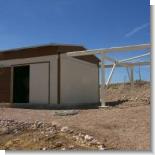 |
Arizona and astronomy seem to go hand in hand: Kitt Peak and Whipple Observatory are two of the major professional research observatories located in Southern Arizona. The factors which have drawn professional observatories to the area have also drawn amateur astronomers as well. A dream of mine for 20+ years has been to move to the desert southwest and build an observatory and large telescope on my property. Luckily, I was in a position to do this very thing and the result is pictured above.
This is Sonoita Hills Observatory, located in SE Arizona at an elevation of 5050 feet. The building is a simple roll off roof type, 16X16 foot square, with 8 foot high walls. It is painted to match (well, almost) the color of my house in order to keep my neighbors happy. |
Sonoita Hills Observatory Rolling Roof
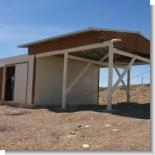 |
This shows the observatory with the roof rolled off. The roof utilizes metal trusses and a metal roof. Besides costing less than a traditional wood roof, it is lighter than wood by a significant margin. The eight wheels are 6 inch metal V roller wheels and they ride on an angle iron track, welded to 1/4" steel plate which is in turn bolted to the top plate of the building and the roof support structure. Due to local building regulations, the roof hold-down system had to be designed by an engineer to withstand 80mph winds. |
Takahashi Mewlon 300
 |
Currently SHO is primarily pursuing color CCD imaging. The current main telescope is a Takahashi Mewlon 300, a 12" Dall-Kirkham Cassegrain type telescope. A Dall-Kirkham uses a prolate ellipsoid primary mirror and a spherical secondary mirror. While this type of telescope suffers from coma, when coupled with a SBIG ST10XE CCD camera, there is minimal coma at the edge of the field and smaller objects can be imaged because of the long focal length. The telescope is generally used in its native optical configuration without the use of a reducer yielding a focal length of about 3522mm at about F/11.75, giving a field of view about 14.5 X 9.75 minutes of arc. This is certainly not a wide field instrument. An Optec TCF-S focuser is coupled to the back of the Mewlon to allow the use of various automatic focusing programs such as Focusmax.
The telescope is guided during long CCD exposures by a Takahashi FS102 refractor using an SBIG ST237A CCD camera as the guide camera.
All of this resides on a Software Bisque Paramount ME robotic telescope mount. The ME is wonderfully accurate and there are numerous software programs that can further enhance performance including tracking and pointing. Currently a SBIG ST10XE CCD camera is used with an SBIG CFW8A color filter wheel containing Astrodon filters.
In summation, this has proven to be a robust and versatile system within limitations. In order to capture smaller deep-sky objects, the telescope is used in its native configuration, which, unfortunately, means that it is used at its native slow focal length. It is not uncommon to have over four hours of exposure on just a single object, sometimes stretching over several nights! And while the coma would be a problem with a larger CCD chip, any coma can be easily cropped out of the final CCD image. The end results prove that quite a bit can be done with a 12" telescope.
Mike J. Shade
Director, Sonoita Hills Observatory, Sonoita Arizona
www.sonoitaobservatories.org
|


|
| |
Alkira Observatory (AO)
Desert Coyote Observatory (DCO)
Desert Starlight Observatory (DSO)
Discovery Observatory West (DOW)
High Knolls Observatory (HKO)
Junk Bond Observatory (JBO)
Palominas Observatory (PO)
RepoGazer Observatory (RGO)
Song of the Lamb Observatory (SOLO)
Sonoita Hills Observatory (SHO)
Tombstone Observatory (TO)
Wind Spirit Observatory (WSO)
|


)
)
)